
Department of Occupational Safety and Health - Undergraduate programs
- 1. Overview of Department of Occupational Safety and Health
-
Occupational safety and health is a field of study that anticipates new trends in the globalized economy. It applies knowledge of occupational safety and hygiene to research the causes and find solutions to prevent workplace accidents, harmful factors affecting health and the environment, and fire and explosion incidents in production, etc., in order to ensure the health and safety of workers.
The Occupational Safety and Health program trains students to become engineers in the field of occupational safety and health (OHS). Occupational safety and health engineers can confidently apply for jobs in all manufacturing businesses, multinational corporations, construction projects, and state management agencies on occupational safety in positions such as consultants for building occupational safety and health systems according to international standards; experts in operating and evaluating occupational safety and health systems; Graduates can work as labor risk management specialists, assessors of quality management, safety, and environmental management systems in businesses, and inspectors responsible for inspection and certification at state management agencies on occupational safety and health. In addition, graduates can start their own companies providing consulting, training, and incident response services related to occupational safety and health for individual and corporate clients.
The training program is designed with over 40% of the learning time spent in businesses and practical training rooms, with instruction from scientists in the field of occupational safety and health and experts working in businesses.
Occupational Safety Engineers can work in all businesses, multinational corporations, domestic and international, regardless of the type of production or business.
Upon graduation, students will acquire the following knowledge and skills:
- Computer Science: International MOS certification (750 points);
- Proficient in applying computer skills in the workplace;
- Foreign languages: IELTS 5.5 (Engineer) and IELTS 5.0 (Bachelor) or other equivalent international English certificates.
- Soft skills: teamwork, independent work, project management.
- Professional knowledge and skills: investigation, surveying, analysis, evaluation and management of the working environment; proposing technological and organizational solutions to ensure occupational safety and health and protect the health of workers.
- 2. Expected learning outcomes
-
Students of the Occupational Safety and Health program are expected to succeed in the following aspects within 3 – 5 years after graduation:
- Name of programme: Occupational Safety and Health
- Level: Undergraduate
- Programme code: 7850201
- Training degree: Engineer (5 years); Bachelor (4 years)
- Mode of study: Full time
Programme Educational Objectives (PEOs):
- Graduates have a solid theoretical and practical background in the occupational safety and health field; skills of independent working and creative thinking to work successfully in the national and international labour markets.
- Graduates display the capability of proposing research ideas and conducting research; and systems thinking ability in the field of occupational health and safety.
- Graduates will pursue higher level degrees for a career in occupational safety and health, be engaged in lifelong learning, and demonstrate a high level of professionalism, ethical and social responsibility in the process of international development and integration.
Programme learning Outcomes- PLOs:
No
Degree
Classification based on types of knowledge
Description of PLOs
Measurement
Bachelor
Engineer
1
X
General knowledge
PLO1a:Demonstrate proficient use of general knowledge of foreign languages and information technology in accordance with international standards; effectively apply knowledge and skills in political theory, natural sciences, and social sciences to meet the fundamental requirements of the Occupational Safety and Health discipline.
Satisfy the requirements of the courses according to the correlation matrix of PLO1a in the curriculum.
Obtain the National Defense Education Certificate
Obtain IELTS 5.5 certificates and MOS 750.
X
PLO1b: Demonstrate proficient use of general knowledge of foreign languages and information technology in accordance with international standards; effectively apply knowledge and skills in political theory, natural sciences, and social sciences to meet the fundamental requirements of the Occupational Safety and Health discipline.
Satisfy the requirements of the courses according to the correlation matrix of PLO1b in the curriculum.
Obtain the National Defense Education Certificate
Obtain IELTS 5.5 certificates and MOS 750.
2
X
General Skill
PLO2a: Demonstrate teamwork and independent working skills, systems thinking, and effective communication and presentation skills.
Satisfy the requirements of the courses according to the correlation matrix of PLO2a in the curriculum.
Participate and satisfy the requirements of the Sustainable Development skills courses according to the curriculum.
X
PLO2b: Demonstrate teamwork and independent working skills, systems thinking, and effective communication and presentation skills.
Satisfy the requirements of the courses according to the correlation matrix of PLO2b in the curriculum.
Participate and satisfy the requirements of the Sustainable Development Skills courses according to the curriculum.
3
X
X
Social attitudes and consciousness
PLO3: Demonstrate professional ethics, social responsibility, environmental awareness, and active participation in community activities.
Satisfy the requirements of the courses according to the correlation matrix of PLO3 in the curriculum.
Satisfy the requirements of extra-activities score according to the student regulations.
4
X
X
Specialized knowledge
PLO4: Analyse and apply laws and subordinate legal documents, knowledge of human biological principles, and health behaviours in order to provide consultation, management, and organisation for occupational safety and health services in enterprises; and provide consultation on the organisation and management of occupational safety and hygiene activities.
Satisfy the requirements of the courses according to the correlation matrix of PLO4 in the curriculum.
5
X
X
PLO5: Select the optimal solutions in technical handling of the working environment based on the basic principles, application principles and current situation of the enterprise.
Satisfy the requirements of the courses according to the correlation matrix of PLO5 in the curriculum.
6
X
Specialized skills
PLO6a: Apply knowledge of pollution reduction and prevention in the working environment, sustainable production practices, and solutions to assess the current status of occupational safety and health at the enterprise.
Satisfy the requirements of the courses according to the correlation matrix of PLO6a in the curriculum.
X
PLO6b: Apply knowledge of pollution minimisation and prevention in the occupational environment, sustainable production practices, and intervention measures to assess current conditions and propose solutions to improve the quality of occupational safety and hygiene in enterprises.
Satisfy the requirements of the courses according to the correlation matrix of PLO6b in the curriculum.
7
X
PLO7a: Provide consultation and propose services in occupational safety, occupational hygiene, and occupational safety and health for enterprises, as well as hazard control and risk management solutions.
Satisfy the requirements of the courses according to the correlation matrix of PLO7a in the curriculum.
Satisfy the requirements of the professional practice skills exam.
X
PLO7b: Provide consultation, propose, and implement services in occupational safety, occupational hygiene, and occupational safety and health for enterprises, as well as hazard control and risk management solutions.
Satisfy the requirements of the courses according to the correlation matrix of PLO7b in the curriculum.
Satisfy the requirements of the professional practice skills exam
8
X
X
PLO8: Develop training programmes on occupational safety and hygiene and occupational safety and health for all target groups in accordance with the Law on Occupational Safety and Hygiene.
Satisfy the requirements of the courses according to the correlation matrix of PLO8 in the curriculum.
Satisfy the requirements of the professional practice skills exam
9
X
PLO9a: Evaluate environmental treatment systems in enterprise production activities; safety assurance systems for chemicals, fire and explosion, and pressure equipment; and safety assurance systems for work at height and work in confined spaces.
Satisfy the requirements of the courses according to the correlation matrix of PLO9a in the curriculum.
Satisfy the requirements of the professional practice skills exam
X
PLO9b: Evaluate and design the environmental treatment systems in enterprise production activities; safety assurance systems for chemicals, fire and explosion, and pressure equipment; and safety assurance systems for work at height and work in confined spaces.
Satisfy the requirements of the courses according to the correlation matrix of PLO9b in the curriculum.
Satisfy the requirements of the professional practice skills exam
10
X
X
PLO10: Apply scientific research achievements and develop new research directions on sustainable use of natural resources and propose solutions to ensure occupational health and safety.
Satisfy the requirements of the courses according to the correlation matrix of PLO10 in the curriculum.
Satisfy the requirements of the professional practice skills exam.
Participate in academic seminars and periodic applied research workshop.
Participate and satisfy the scientific research projects for student at university level.
- 3. Education program
-
The programme objectives are to train students to have the solid knowledge background in both theory and practice, the independent working skills, a creative thinking to be able to integrate and develop in the labor market of Vietnam and the world that requires the highly qualified. Students have the research skills, the scientific manners, the ability to propose research ideas, and the systematic thinking ability in the area of Safety, Health, and Environment. Students have the sense of learning and improving their knowledge in the spirit of lifelong learning; have the professional manners and attitudes in the multinational environment; have the responsibility to protect the health and safety of workers in the process of development and international integration.
At the end of each semester, according to the procedures of compiling and editing the course specification of TDTU, all course specification of DOSH program will be considered to improve. This process is normally conducted every 2 years. However, in the special cases, when the stakeholders (e.g. students, lecturers, imployers, and alumni) raise any request, for instance, the Head of DOSH will submit a proposal to the Dean who then show further suggestion to the University Board for asking the approval. The course specification is then allowed to be reviewed and adjusted. Finally, the outline will be approved by the University Board and put into operation to replace the expried one.
Education Program of DOSH: See attached file
- 4. Career prospects
-
- Occupational Safety Engineers are fully qualified to work in Vietnamese and international businesses;
- Occupational Safety Engineers can work in all manufacturing businesses, multinational corporations, construction projects, and state management agencies on occupational safety;
- There are good job opportunities with good salaries and career advancement opportunities in foreign-invested companies, multinational corporations, and construction projects.
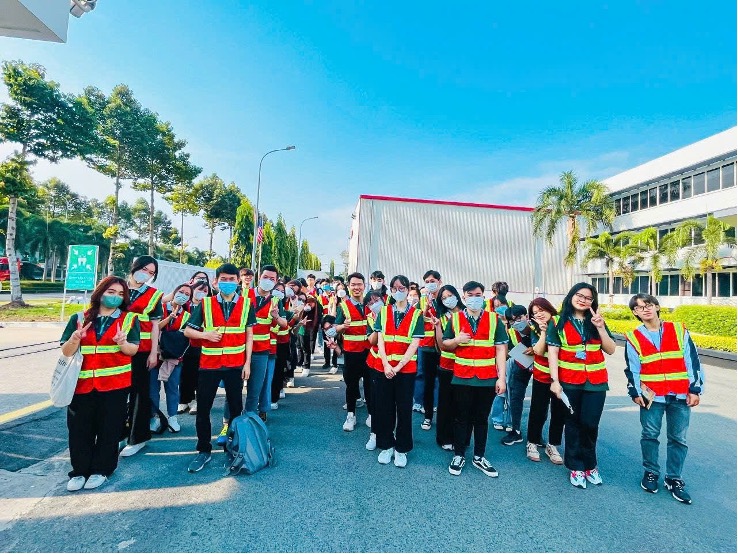
Students majoring in Occupational Safety and Health go on practical training at businesses.
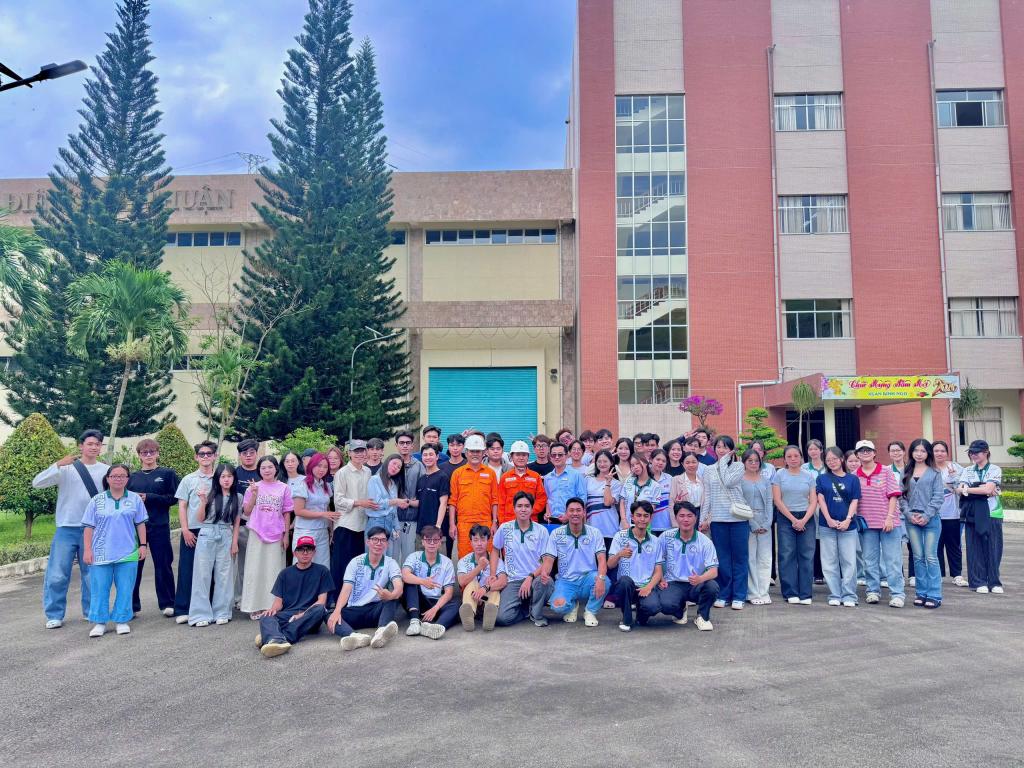
Students majoring in Occupational Safety and Health go on a field trip to the factory.
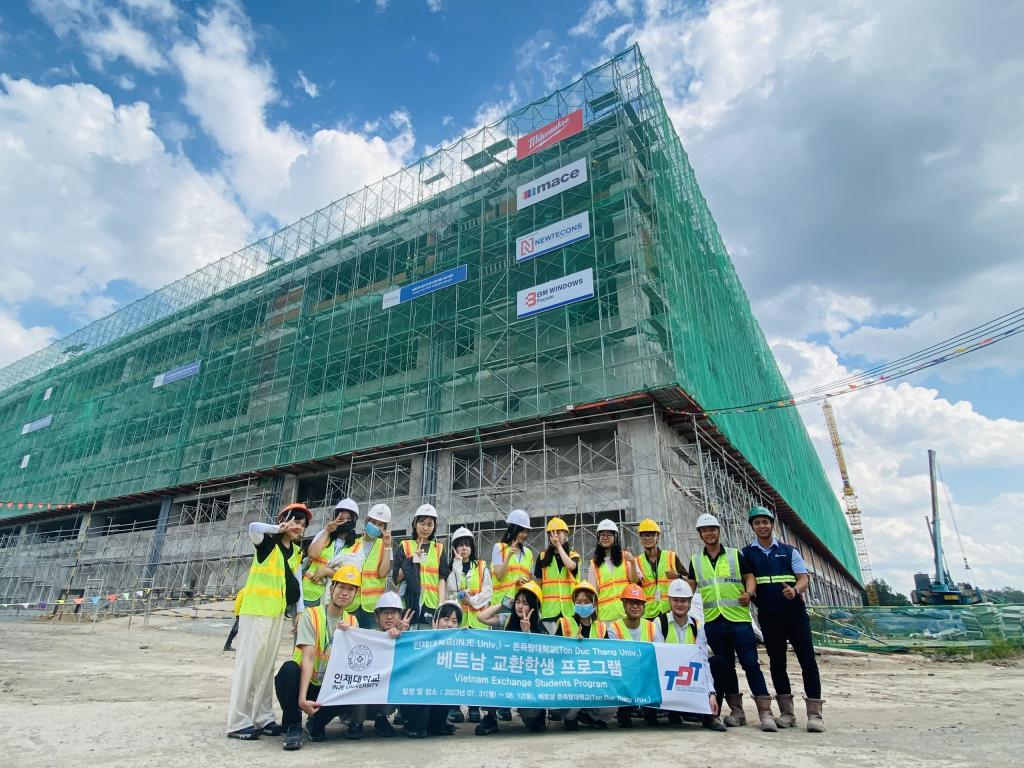
International students from the Faculty of Occupational Health and Safety Engineering (Inje University, South Korea) participated in the Global Occupational Health and Safety course organized by the Faculty of Environment and Labour Safety (TDTU).